Embroidery enthusiasts rejoice! Discover a wealth of free printable stitch guides, perfect for building your skills. These PDF resources, like Pauline Brown’s encyclopedia, offer accessible learning.
Collect and organize these guides – lamination and binder rings create a durable, portable reference. Enjoy exploring 100+ stitches without cost!
The Appeal of Free Resources
Free embroidery resources democratize the craft, removing financial barriers to entry for aspiring stitchers. The availability of PDF stitch guides, often offering comprehensive coverage of techniques – even approaching 100 stitches – is incredibly empowering. This accessibility allows individuals to explore the art of embroidery without a significant initial investment in expensive books or classes.
These downloadable resources are particularly appealing to beginners, providing a low-risk way to learn fundamental stitches and build confidence. The convenience of printing and keeping these guides readily available in a sewing box, perhaps laminated for durability, further enhances their value.
Furthermore, the digital format allows for easy storage and access, eliminating the need for physical shelf space. The wealth of options, including those found on platforms like Etsy, means there’s a style and approach to suit every learner. It’s a fantastic way to cultivate a new hobby or expand existing skills, all thanks to the generosity of creators sharing their knowledge freely.
Why a Stitch Book is Essential
An embroidery stitch book, even a free PDF download showcasing 100 stitches, serves as the cornerstone of any embroiderer’s journey. It’s more than just a collection of diagrams; it’s a visual encyclopedia of techniques, offering a structured approach to learning and mastering various stitches. Having a readily available reference eliminates guesswork and ensures consistency in your work.
Whether you’re a beginner or an experienced crafter, a stitch book facilitates experimentation and creative exploration. It allows you to quickly identify the appropriate stitch for a specific design element, fostering innovation and personalized expression.
Furthermore, a well-organized stitch book, perhaps printed and bound, becomes a cherished heirloom, passed down through generations of stitchers. It’s a tangible record of your progress and a source of inspiration for future projects. Resources like Pauline Brown’s work provide a solid foundation for building a comprehensive embroidery skillset.
As of January 22nd, 2026, the demand for accessible embroidery resources remains strong, with numerous free PDF stitch guides readily available online. The enduring popularity of hand embroidery, coupled with the increasing accessibility of digital downloads, makes these resources particularly relevant for both novice and seasoned crafters.
The continued circulation of resources like Pauline Brown’s “Encyclopedia of Embroidery Techniques” demonstrates a lasting interest in traditional techniques. The convenience of printable stitch guides – easily laminated and organized – caters to a modern crafting lifestyle.
Today’s digital landscape allows for instant access to a wealth of knowledge, empowering individuals to learn and practice embroidery at their own pace. The availability of free content, including guides showcasing 100+ stitches, democratizes the craft and fosters a vibrant online community.
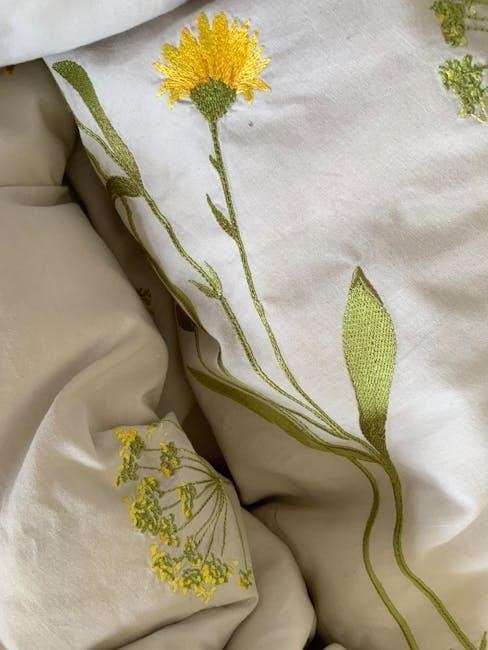
Understanding Embroidery Stitches
Embroidery stitches fall into categories like running, back, and stem. Mastering these basics, alongside filling and outline techniques, unlocks the potential of any free PDF guide.
Basic Stitch Categories: Running, Back, Stem
Embroidery stitches are broadly categorized, forming the foundation for countless designs. The running stitch, a simple in-and-out technique, serves as a base for more complex patterns and is often the starting point for beginners exploring free PDF guides.
The back stitch creates solid lines, ideal for outlining shapes or lettering, offering a more defined look than the dashed effect of a running stitch. It’s a crucial stitch to master from any downloadable resource.
Finally, the stem stitch, characterized by its slightly twisted appearance, is perfect for creating stems, vines, or flowing lines. These three stitches – running, back, and stem – are frequently detailed in introductory embroidery stitch books and free printable guides, providing a solid base for expanding your skillset. Understanding these core techniques unlocks the potential to learn and adapt more intricate stitches found within a comprehensive 100-stitch collection.
Filling Stitches vs. Outline Stitches
Embroidery stitches fall into two primary categories: those used for outlining and those designed for filling areas with texture and color. Outline stitches, like back stitch and stem stitch, define shapes and create clear boundaries within a design, often featured prominently in free PDF guides.
Filling stitches, conversely, cover larger areas, adding depth and visual interest. Whipped running stitch, for example, transforms a simple running stitch foundation into a textured fill. Other filling options include satin stitch and long and short stitch, commonly detailed in comprehensive embroidery books.
A 100-stitch collection will showcase a diverse range of both types, allowing for creative combinations. Mastering both outline and filling techniques is essential for achieving well-rounded embroidery projects. Understanding this distinction, readily available in downloadable resources, empowers you to translate designs effectively onto fabric.
Importance of Fabric and Thread Choice
Selecting the right fabric and thread is paramount to successful embroidery, often emphasized within detailed PDF stitch books. The fabric’s weave impacts stitch definition; tighter weaves suit finer threads, while looser weaves accommodate thicker floss. Linen, cotton, and even silk are popular choices, each offering a unique texture.
Thread weight and material also significantly influence the final look. Embroidery floss comes in various weights (stranded or pearl cotton) and materials (cotton, silk, rayon). A 100-stitch resource will likely demonstrate how different combinations affect stitch appearance.
Consider the project’s purpose when choosing materials. Durable fabrics and threads are best for items receiving frequent use. Experimentation, guided by free resources, is key to discovering preferred pairings and achieving desired aesthetic effects.
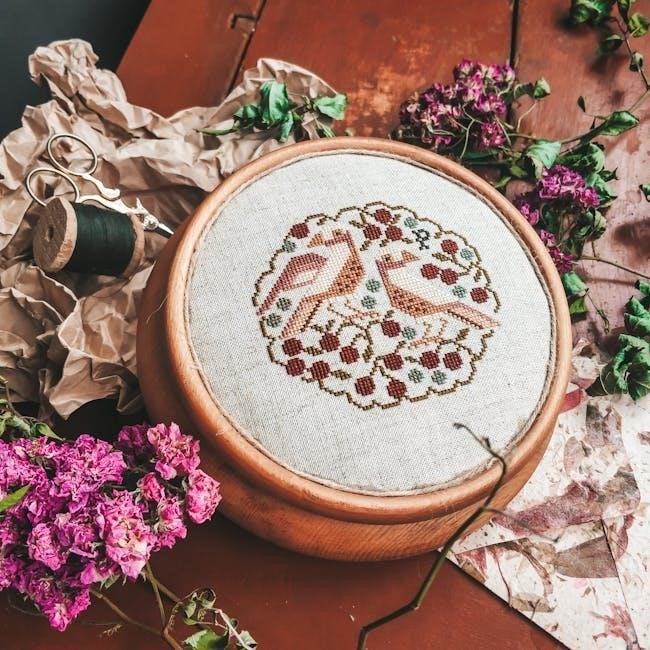
Popular Free Embroidery Stitch Guides (PDF)
Pauline Brown’s “Encyclopedia” is a standout free resource. Etsy offers beginner PDF downloads, while printable stitch collections enhance any sewing box beautifully.
Pauline Brown’s “Encyclopedia of Embroidery Techniques”
Pauline Brown’s comprehensive “Encyclopedia of Embroidery Techniques” stands as a cornerstone for both novice and experienced stitchers seeking a detailed, free resource. Available as a PDF download, this encyclopedia meticulously defines and illustrates a vast array of stitches, forming a robust foundation for any embroidery project.
The document doesn’t limit itself to basic techniques; it delves into more complex stitches, providing clear explanations and visual aids. It’s a fantastic starting point for anyone aiming to master a wide range of embroidery styles. This resource is particularly valuable as it’s freely accessible, removing financial barriers to learning this beautiful craft.
Within its pages, you’ll find descriptions of stitches like back stitch, running stitch, and bullion stitch, alongside guidance on adapting them for various effects. It’s a digital treasure trove for anyone wanting to expand their embroidery skillset and explore the possibilities of needle and thread. Truly a must-have PDF!
Printable Stitch Guides for Sewing Boxes
The charm of a well-organized sewing box is amplified by readily available references. Numerous free, printable embroidery stitch guides are designed specifically for this purpose, offering quick access to essential techniques. These compact PDFs are ideal for keeping alongside your threads and needles, transforming any sewing space into a learning hub.
These guides often focus on core stitches, providing clear diagrams and concise instructions. They’re perfect for refreshing your memory mid-project or learning a new stitch on the fly. Lamination is highly recommended to protect these valuable resources from wear and tear, ensuring longevity and usability.
Collecting a series of these printable guides and binding them with a ring creates a personalized, portable embroidery handbook. It’s a delightful and practical way to build your stitch repertoire and elevate your crafting experience. A fantastic addition to any embroidery toolkit!
Etsy Digital Download Options ― Beginner Guides
While abundant free resources exist, Etsy offers a curated selection of affordable, digital embroidery stitch guides for beginners. These downloadable PDFs often provide a more structured learning experience, frequently including detailed step-by-step photographs and comprehensive stitch libraries. Many sellers specialize in beginner-friendly content, simplifying complex techniques.
These Etsy guides can be a valuable supplement to free resources, offering a focused approach to mastering fundamental stitches. Look for options that include embroidery patterns and tutorials, allowing you to immediately apply your newfound skills. Instant digital access means you can start learning right away!
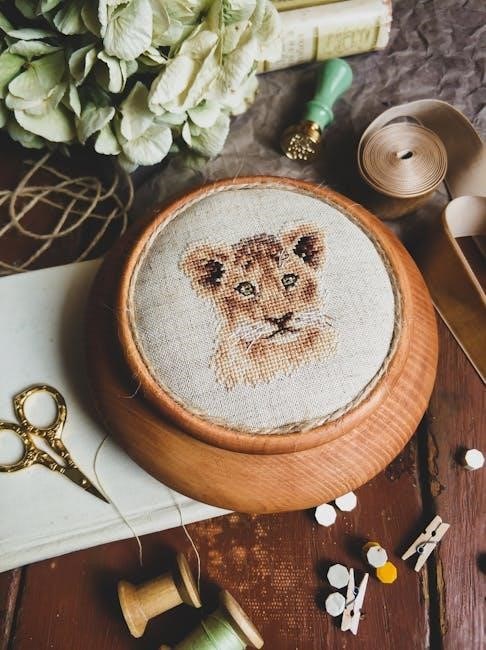
Consider these paid options if you prefer a polished, professionally designed learning tool. They often feature clear layouts and in-depth explanations, accelerating your progress and inspiring creativity. A great investment for dedicated embroidery enthusiasts!
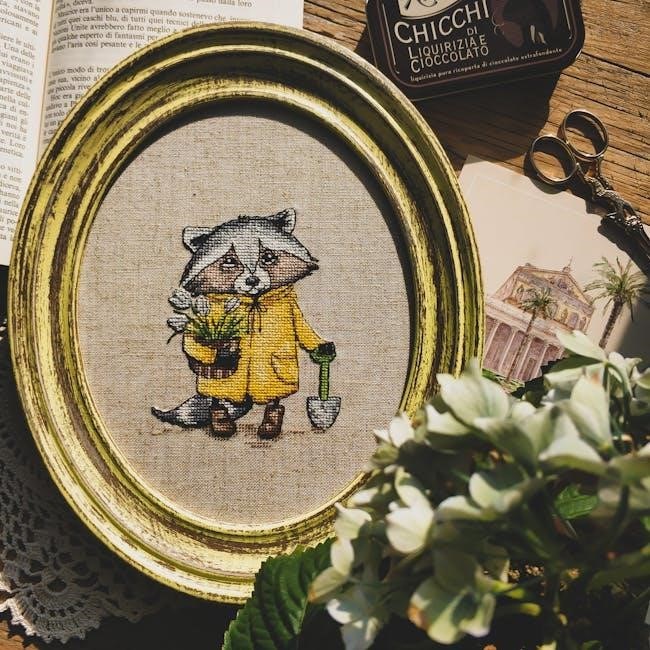
Key Stitches Covered in Free Books
Free embroidery guides commonly feature running, back, and whipped running stitches. These foundational techniques build skills for creating lines, textures, and filling designs.
Running Stitch: Foundation and Variations
The running stitch, a cornerstone of embroidery, serves as a fundamental building block for countless designs. Free guides emphasize its simplicity – a basic in-and-out motion creating a dashed line. However, its true versatility lies in its variations.
By adjusting the stitch length, you can achieve different effects. Shorter stitches create a denser line, while longer stitches offer a more open, textured appearance. The running stitch is ideal for outlining shapes, creating decorative borders, or as a preparatory stitch for more complex techniques.
Furthermore, it forms the base for the whipped running stitch, adding dimension and texture. Mastering the running stitch unlocks a world of creative possibilities, making it an essential skill for any embroidery enthusiast, readily available in free PDF resources.
Back Stitch: Creating Solid Lines
The back stitch is renowned for its ability to produce solid, unbroken lines, making it perfect for outlining intricate designs and lettering in embroidery. Free embroidery stitch guides detail its technique: bringing the needle up a short distance ahead of the previous stitch and inserting it back into the end point of the last stitch.
This overlapping method creates a continuous line with excellent definition. Unlike the dashed appearance of the running stitch, the back stitch offers a smooth, professional finish. It’s a slower technique, but the resulting precision is well worth the effort.
Many free PDF resources showcase the back stitch as a foundational element, essential for achieving clean, detailed work. It’s a must-know stitch for anyone exploring the art of hand embroidery, readily available for learning.
Whipped Running Stitch: Adding Texture
The whipped running stitch elevates a simple running stitch foundation into a textured and visually interesting element. Free embroidery stitch guides emphasize working this stitch on taut fabric, ideally held within an embroidery hoop or frame, for optimal control. First, create a base of closely spaced running stitches.
Then, “whip” around these foundational stitches by wrapping the thread diagonally over them, creating a braided effect. This technique is fantastic for filling shapes and adding depth to designs. It’s also versatile, lending itself to both geometric patterns and more organic forms.
PDF downloads often demonstrate how the whipped running stitch can be used as a filling stitch, offering a unique alternative to solid blocks of color. Explore free resources to master this textural technique!
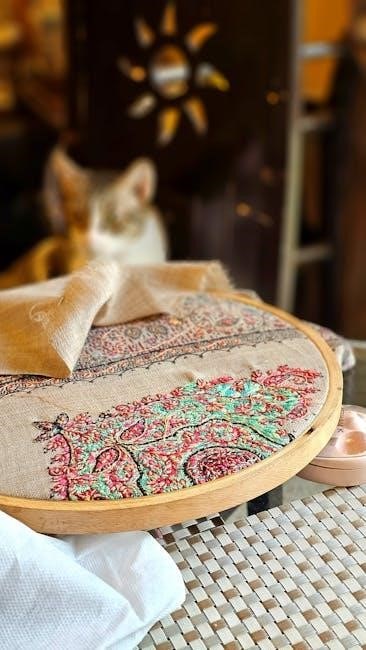
Accessing and Utilizing Free PDF Downloads
Free embroidery stitch guides in PDF format are readily available online. Ensure correct print settings – select “actual size” for accurate results!
Ensuring Correct Print Settings (Actual Size)
Printing your downloaded embroidery stitch guides accurately is crucial for successful stitching. Many printers default to “fit to page,” which unfortunately alters the dimensions of the stitch diagrams. This scaling can render the guides unusable, as the stitch lengths and spacing will be incorrect.
To avoid this, always access your printer settings before initiating the print process. Locate the scaling option – it’s often labeled as “scaling,” “fit to page,” or “size options.” Crucially, disable any automatic scaling and select “actual size” or “100%.” This ensures the printed guide precisely matches the original PDF dimensions.
A quick test print of a small section of the guide is recommended to verify accuracy. Compare the printed stitch lengths to a ruler to confirm they are as expected. Taking this extra step will save frustration and ensure your embroidery projects are beautifully executed!
Lamination and Binder Ring Organization
Once you’ve downloaded and printed your free embroidery stitch guides, protecting them from wear and tear is essential. Lamination is a fantastic solution! It shields the paper from dirt, moisture, and frequent handling, extending the life of your valuable reference material.
Self-adhesive laminating sheets are readily available and easy to use, or you can opt for professional lamination services. After lamination, consider organizing your guides using a binder ring. Punch holes along the edge of each sheet and secure them together for a convenient, flip-through format.
This creates a portable embroidery stitch “book” that’s perfect for taking to workshops, stitching sessions, or simply keeping neatly stored in your sewing space. A well-organized collection will inspire creativity and streamline your embroidery journey!

Saving PDFs for Offline Access
Downloading free embroidery stitch guides in PDF format offers incredible convenience, but relying solely on internet access isn’t always practical. To ensure you can access your resources anytime, anywhere, saving them for offline use is crucial.
Most devices – computers, tablets, and smartphones – allow you to easily save PDF files directly to their storage. Simply download the PDF and choose the “Save” or “Download” option. Organize these files into a dedicated folder for easy retrieval.
This is particularly useful when traveling, during workshops with limited connectivity, or simply when you prefer to disconnect and focus on your stitching. Having your embroidery stitch guides readily available offline empowers you to learn and create without interruption!
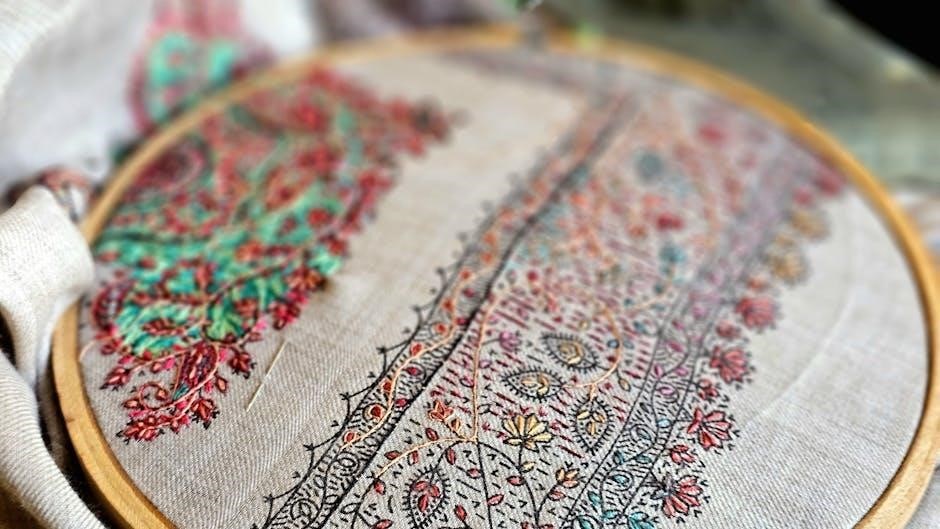
Cross-Stitch Fundamentals from Free Guides
Free guides detail cross-stitch, working right to left with needle points 1-4. Repeat these steps consistently to achieve desired lengths and patterns!
Working Cross-Stitch from Right to Left
Cross-stitch, a cornerstone of embroidery, is traditionally worked from right to left, creating a neat and consistent texture. Begin by bringing the needle up at point 1, then inserting it diagonally at point 2. Next, bring the needle back up at point 3, completing the first half of the ‘X’.
Finally, insert the needle at point 4 to finish the cross-stitch. This methodical approach ensures that all stitches slant in the same direction, resulting in a polished appearance.
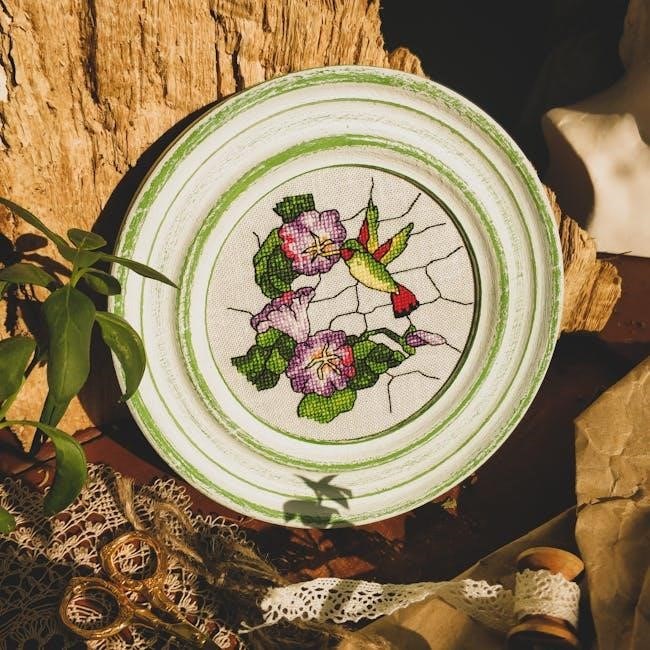
Many free PDF guides emphasize this technique, illustrating the precise needle insertion points. Consistent practice is key to mastering this fundamental embroidery stitch. Remember to maintain even tension throughout each stitch for a professional finish. Repeating this sequence builds the desired length and density of your cross-stitched design.
Needle Insertion Points (1, 2, 3, 4)
Understanding needle insertion points is crucial for executing neat cross-stitch. These points – numbered 1 through 4 – define the diagonal path of each stitch. Starting at point 1, the needle descends into the fabric at point 2, forming the first diagonal line of the ‘X’.
Subsequently, the needle emerges at point 3, and then re-enters at point 4, completing the cross. Visual aids within free embroidery stitch guides (often available as PDF downloads) clearly demonstrate this process.
Maintaining consistent needle placement ensures uniform stitch size and direction. Precise control over these four points is essential for achieving a polished, professional look. Practice identifying and utilizing these points to elevate your embroidery skills and create beautiful designs.
Repeating the Stitch for Desired Length
Once you’ve mastered the initial cross-stitch sequence (points 1, 2, 3, and 4), repeating the process is key to covering the desired length of your design. Consistent repetition builds a solid line or fills an area with texture. Free embroidery stitch guides, often found as downloadable PDFs, emphasize the importance of rhythm and even spacing.
Maintain a steady hand and consistent tension as you move across the fabric. Avoid pulling the thread too tightly, which can distort the fabric. Instead, aim for a balanced stitch that lies flat.
Referencing visual examples within these free resources will help you achieve uniformity. Practice makes perfect – the more you repeat the stitch, the more natural and fluid your technique will become, resulting in beautiful embroidery!